WHAT YOU NEED TO KNOW
Physics graduates can investigate technical, analytical and computational work as well as further research. The right route depends on your practical evidence and the job’s entry requirements; specialist clinical, engineering and academic roles may require additional qualifications.
Look beyond jobs called physicist
A degree can develop modelling, measurement, uncertainty analysis and programming, but your own module and project choices determine what you can demonstrate. Search by those tasks as well as by degree title. Read whether an employer accepts physics or related subjects rather than assuming eligibility.
The US Bureau of Labor Statistics distinguishes research and academic physicist or astronomer roles, which typically require a PhD, from some bachelor’s-level work. Its US guidance is useful context, not a guarantee that a particular employer or country accepts your qualification.
Pick a direction to test
The question is not whether every listed career is theoretically possible. It is which next step is plausible with your present evidence.
| Direction | Evidence that helps | Gap to investigate |
|---|---|---|
| Instrumentation and testing | Calibration, measurement and uncertainty report | Equipment and safety training |
| Computational or data work | Documented simulation or analysis code | Software practices and domain knowledge |
| Research | A carefully explained project and methods | Postgraduate requirements and funding |
| Clinical or regulated engineering work | Relevant foundation and interest | Accredited training, supervised practice and registration |
Explain a project from question to limitation
Choose a project you can discuss in detail. State the physical question, assumptions, method, result and how you checked it. Show where a model stops being useful. An employer needs to see judgement as well as equations.
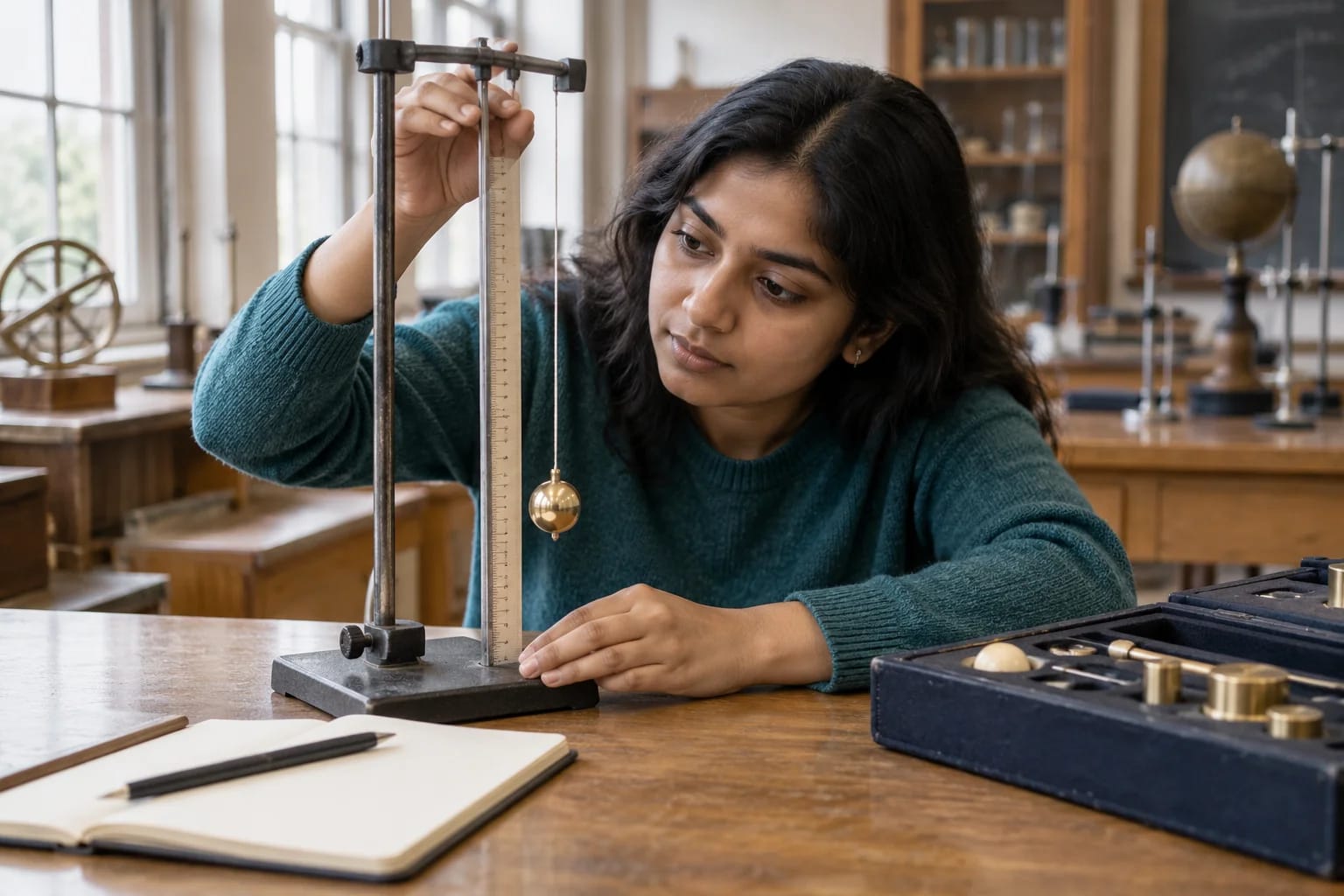
For example, a pendulum investigation can compare an ideal model with measured periods, explain timing uncertainty and identify where the small-angle assumption becomes less suitable. Describe what you measured and what you simulated separately. Do not present generated values as experimental data.
If using code, provide a small reproducible example and instructions. If showing apparatus, include a diagram or photograph only where you have permission. Avoid sharing restricted laboratory details or identifiable research participants.
Do not skip professional boundaries
A physics degree does not by itself authorise clinical treatment, independent medical-device practice or use of a protected professional title. Before paying for a conversion course, identify the actual regulator or accrediting body and ask whether the route meets its requirements.
The same caution applies to broad claims about what a discipline can predict. Modelling and measurement often involve uncertainty; do not turn a general interest in geophysics into a promise to predict earthquakes or prevent disasters.
Make postgraduate study a considered choice
For research, investigate supervisors, available projects, facilities and funding terms. For an industry transition, ask whether a focused project or employer training could address the gap more directly than another degree. Compare the total cost and the work you want afterwards.
Your next action is to choose two roles and map one project to each. Write a different short explanation for the laboratory manager and the software recruiter: the underlying work can be the same, but the relevant evidence will differ.
- Separate observed, measured and simulated results.
- State assumptions and uncertainty.
- Check professional recognition before buying training.
- Use actual vacancies to choose skills to develop.
Sources and further reading
Sources checked 2026-10-12. Examples and planning suggestions are Effikos editorial guidance.
Something needs a closer look? Send us a correction.